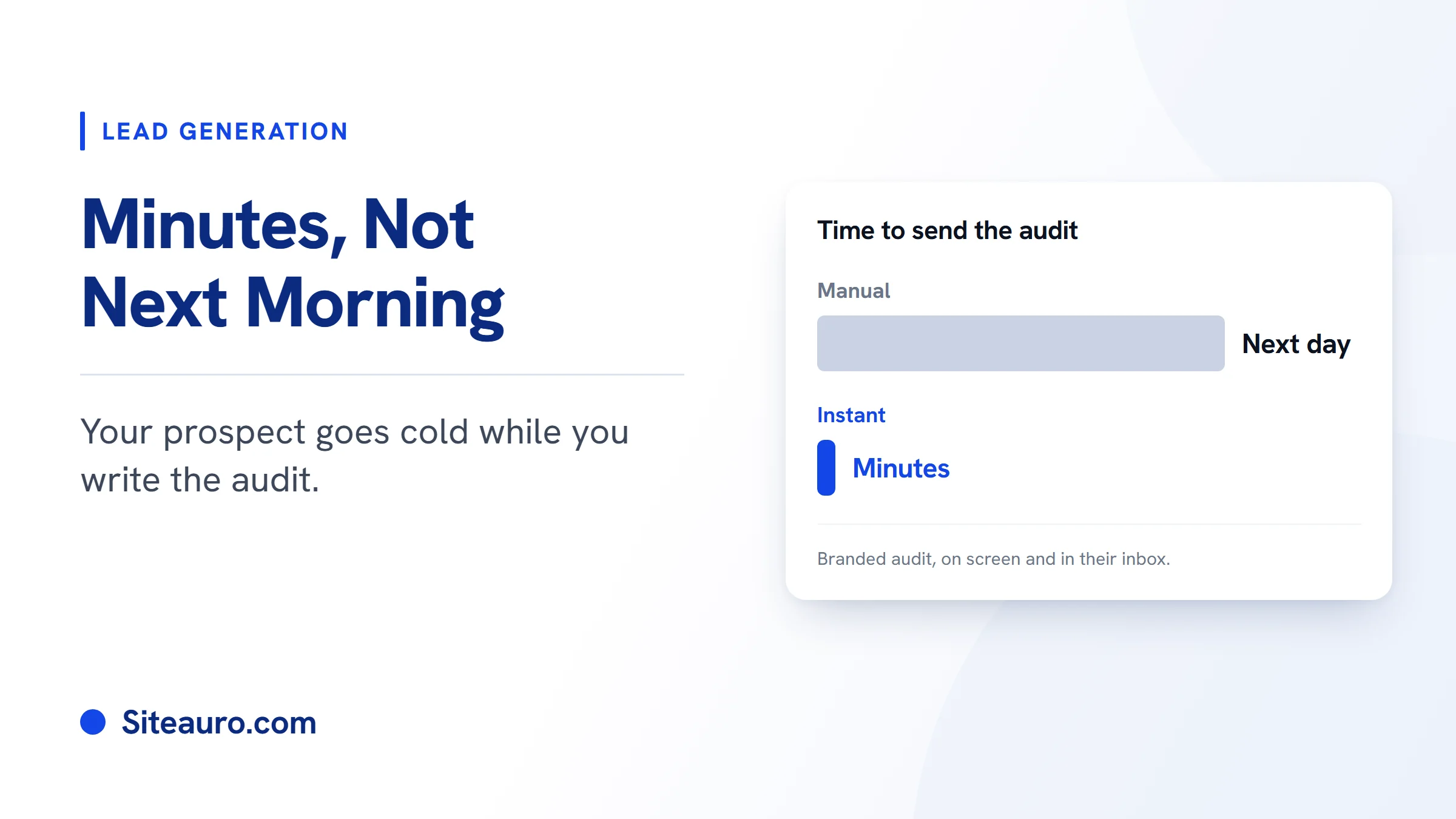
Speed to Lead for SEO Agencies: Your Prospect Goes Cold While You Write the Audit
For agencies the slow part is rarely the inbox — it is the audit. Here is what the speed-to-lead data actually says, including the one stat almost everyone misattributes.
By Karthick, Founder of SiteAuro · · 8 min read
A prospect fills in your audit form on Tuesday morning. They want to know why their site isn't ranking. Your team builds the audit by hand, and it goes out on Wednesday morning.
By then, they may have already talked to another agency. That gap has a name: speed to lead. For SEO agencies, the slow part is rarely the inbox. It's the audit.
This post covers what the real speed to lead data says, including one stat almost everyone gets wrong. Then it shows why agencies fall behind, and how to send a branded audit and a follow-up email within minutes.
What Is Speed to Lead?
Speed to lead is the time it takes to respond to a new inbound lead. The clock starts when someone fills in a form, books a call, or asks for an audit. It stops at your first real reply.
You'll also see it called lead response time. Both terms mean the same thing.
For agencies, speed to lead matters a lot. Someone asking for an SEO audit may be asking other agencies too. The first one to send something useful sets the bar the others get judged against.
What the Speed to Lead Data Really Says
Most companies answer leads slowly, and faster replies qualify and convert more leads. Here are the studies worth trusting, with what each one actually measured.
Study
Sample
Key finding
Harvard Business Review, 2011
2,241 U.S. companies
23% never replied. Those that did took 42 hours on average.
InsideSales, 2021
5.7 million leads, 400+ companies
About 8x higher conversion when the first call came within 5 minutes.
RevenueHero, 2024
1,000 B2B SaaS companies
63.5% never replied to a demo request.
Harvard Business Review (2011). HBR audited 2,241 U.S. companies. Only 37% replied to a web lead within an hour. 24% took more than a day, and 23% never replied at all.
Among the companies that did reply, the average wait was 42 hours. HBR also found that firms that tried to reach a lead within an hour were nearly 7 times as likely to qualify it as firms that waited even one hour longer.
InsideSales (2021). InsideSales looked at 5.7 million inbound leads at more than 400 companies. Conversion rates were about 8 times higher when the first call happened within 5 minutes. Keep in mind that this measured phone calls, not emails.
RevenueHero (2024). RevenueHero sent demo requests to 1,000 B2B SaaS companies. 63.5% never replied. The rest took 1 day, 5 hours, and 17 minutes on average.
One detail matters for agencies. Companies that automated their first reply averaged about 17 hours. Companies that replied by hand took more than 2 days.
The "HBR 5-Minute Rule" Is Misattributed
Many blogs say Harvard Business Review found you must reply within five minutes. Read the original HBR article and you won't find five minutes in it.
The number comes from a 2007 study by InsideSales.com and researcher James Oldroyd. It used call records from six companies, covering about 15,000 leads. Calling within 5 minutes instead of 30 made reaching the lead 100 times more likely and qualifying them 21 times more likely.
That study did not measure closed deals. So the five-minute finding is real, but it's smaller and narrower than the way it's usually quoted.
The lesson still holds across every study. Faster beats slower, and the first hour matters most.
Why SEO Agencies Are Slow to Follow Up
Most agencies aren't slow because they ignore leads. They're slow because the thing the prospect asked for takes hours to build.
A manual audit usually looks like this:
Run the site through a crawler.
Pull rankings, traffic, and backlink data.
Pick out the problems that matter for this business.
Write it up in plain language.
Put it in a branded template and send it.
Each step makes sense. Together, they take a day or two. And they compete with paying client work, which always wins.
Timing makes it worse. A request that comes in on Friday night sits until someone is back on Monday.
We've seen this pattern while building SEO software. The audit is what prospects ask for, and it's also the slowest thing to make by hand. So the prospect waits at the exact moment they're most interested.
How to Improve Speed to Lead With Instant Audits
The fastest fix is to stop building the first audit by hand. With SiteAuro, the audit is created automatically and delivered under your agency's brand within minutes.
The prospect enters their website URL. They use the audit offer on your site.
AI builds a personalized SEO audit. The report is branded as your agency's own, not SiteAuro's.
The report is delivered within minutes. It shows on screen and lands in their inbox.
The lead is saved in Contacts. You can track each lead's status in one place.
A follow-up email goes out automatically. It's sent from your own domain, so it reads like it came from you.
Your team still does the deeper strategy work. But the first touch happens while the prospect is still on your site.
Manual audit
Instant audit with SiteAuro
Time to deliver
1 to 2 days
Minutes
Who builds it
Your team, between client work
SiteAuro's AI, under your brand
Request at 11pm Saturday
Waits until Monday
Delivered right away
Where the lead goes
Wherever someone saves it
Contacts, with status tracking
First follow-up
When someone remembers
Automatic, from your domain
How to Set Up an Automated First-Touch Email
You need three things: the Smart Tracker on your site, a segment for audit requests, and an email automation that starts when someone joins that segment.
Add the Smart Tracker to your site. Paste the SiteAuro snippet. It records which pages visitors view and how long they stay.
Check the Visitor Log. Before you build anything, see who's visiting and what they look at. This shows you what your best prospects do before they ask for an audit.
Create a segment for audit requests. Group the visitors who requested an audit. You can also add a second segment for audit requesters who viewed your pricing or services page. Those are your warmest leads.
Build the email on the automation canvas. Open Email Automation and set it to start when a visitor joins your audit segment. Then add your first-touch email.
Send from your own domain. Connect your SMTP so the email comes from your agency's address, not a shared tool domain.
Test it. Request an audit for your own website. Check the report, the email, and the new entry in Contacts.
What to Write in the First-Touch Email
Keep it short. The audit does the heavy lifting, so the email only needs to point to it and offer one next step.
Thank them and link to the report.
Give one clear next step, like a short call.
Sign it from a real person, not "The Team."
Here's a simple version you can adapt. Swap the bracketed parts for your own details.
Subject: Your SEO audit for [website]
Hi [first name],
Your SEO audit for [website] is ready. You can view it here: [report link]
It lists the issues holding your site back, starting with the ones that matter most.
Want me to walk you through it? You can book a 15-minute call here: [booking link]
[Your name] [Agency name]
What Still Needs a Human
Automation handles the first touch. Winning the client is still your job.
The data supports this. The 8x lift in the InsideSales study came from first phone calls. So let the instant audit open the conversation, then call while the prospect's interest is high.
Before you call, open the lead in Contacts and check the Visitor Log to see what they looked at. If they went to your pricing page, talk about packages. If they read case studies, lead with results.
Aim to call the same day, and within the first hour if you can. Then update the lead's status in Contacts so nothing slips.
Speed to Lead FAQ
What is a good lead response time for an SEO agency?
Send something useful right away, and follow up personally within an hour. HBR found that trying to reach a lead within an hour made qualifying them nearly 7 times as likely. An instant audit covers the first part, so your call covers the second.
Is the 5-minute rule from Harvard Business Review?
No. The HBR article doesn't mention five minutes. The rule comes from a 2007 InsideSales.com study of six companies, which measured contact and qualification, not closed deals.
Does an automated email count as a first response?
Yes, if it gives the prospect something useful. A "thanks, we'll be in touch" email doesn't move things forward. An email that links to their audit does, because it answers what they asked for.
Should I still call a lead after sending an automated audit?
Yes. The audit gets you in early, and the call is where you win the work. Calling soon after they read the report keeps the conversation going while they still care.
How do I follow up with inbound leads outside business hours?
Automate the first touch. With an instant audit and an email automation, a request at 11pm on a Saturday gets a full report and a follow-up right away. Your team picks it up on Monday with the lead already warm.
Get Your Free Lead Intelligence Map
Enter your website — see exactly how to turn more visitors into leads, and
leads into customers.