
Most SaaS trials end the same way. A user signs up, looks around, and leaves without paying.
If you want better trial to paid conversion, you need to know what each trial user actually does. Then you need to respond to it. A generic day-3 email can't do that.
This guide covers the benchmarks, why trials stall, the signals that predict who will pay, and how to act on those signals with behavior tracking.
What Is a Good Trial to Paid Conversion Rate?
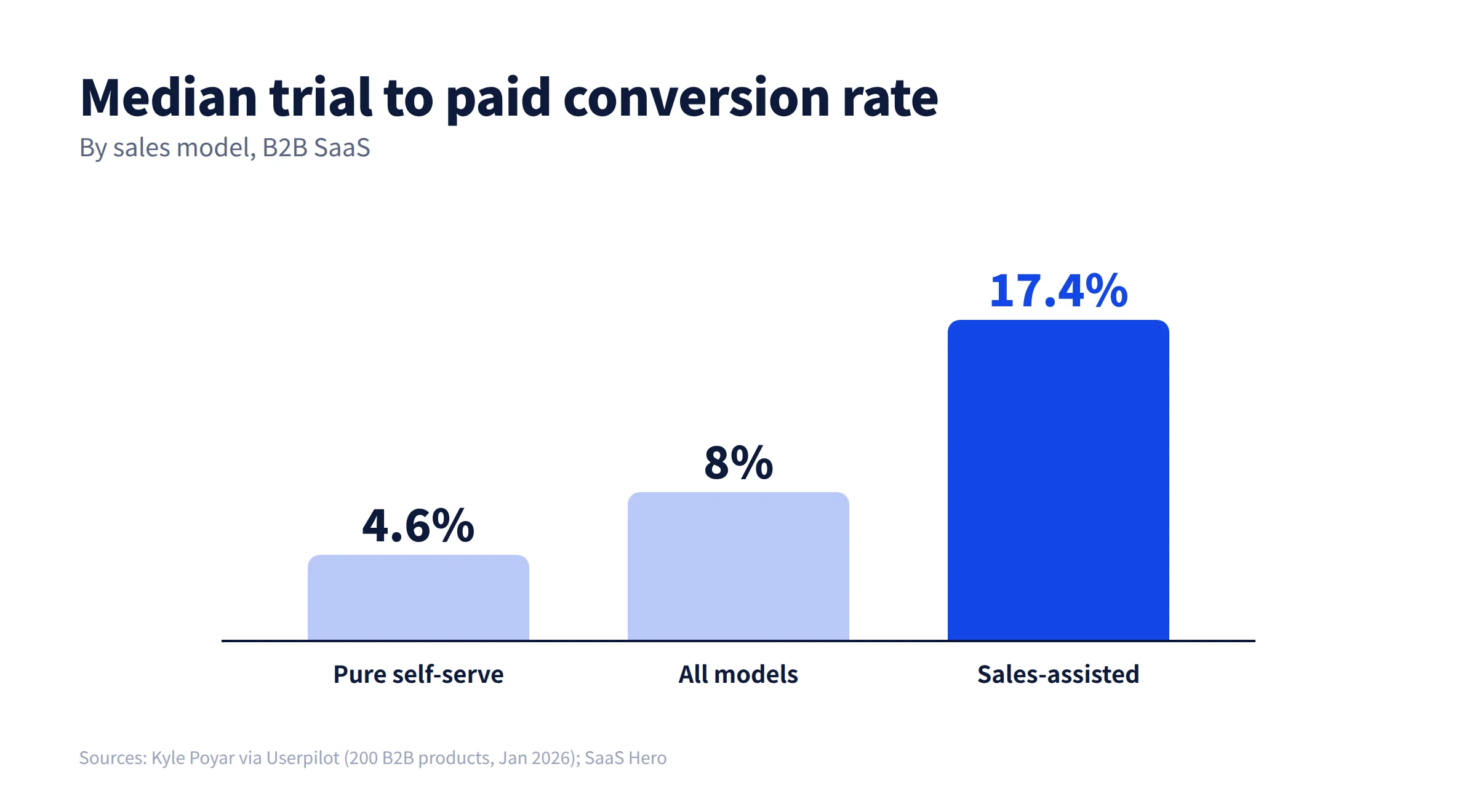
A typical SaaS free trial converts about 8% of users to paid. Kyle Poyar puts the median at 8%, based on 200 B2B software products analyzed in January 2026 with ProductLed and ChartMogul (Userpilot).
Your SaaS trial conversion rate depends a lot on how you sell.
| Sales model | Median trial to paid rate |
|---|---|
| All models | 8% |
| Pure self-serve | 4.6% |
| Sales-assisted | 17.4% |
Source: SaaS Hero
Trial to paid conversion rate is the share of trial signups who become paying customers. To work it out, divide paid conversions by trial signups, then multiply by 100.
Why do sales-assisted trials convert so much better? A person follows up. That person knows what the buyer needs and talks about that. Behavior tracking gives self-serve products some of the same context, without a sales call.
Why Do SaaS Trials Stall?
Trials stall when users never reach the moment where the product proves its value. They sign up with a goal. Then something gets in the way.
Common reasons:
- Setup is too long. The user skips a key step and never sees the real product.
- Onboarding is the same for everyone. It shows features the user doesn't care about.
- The user gets busy. They plan to come back. They don't.
- Nudges come at the wrong time. A "your trial ends soon" email lands before the user has done anything worth paying for.
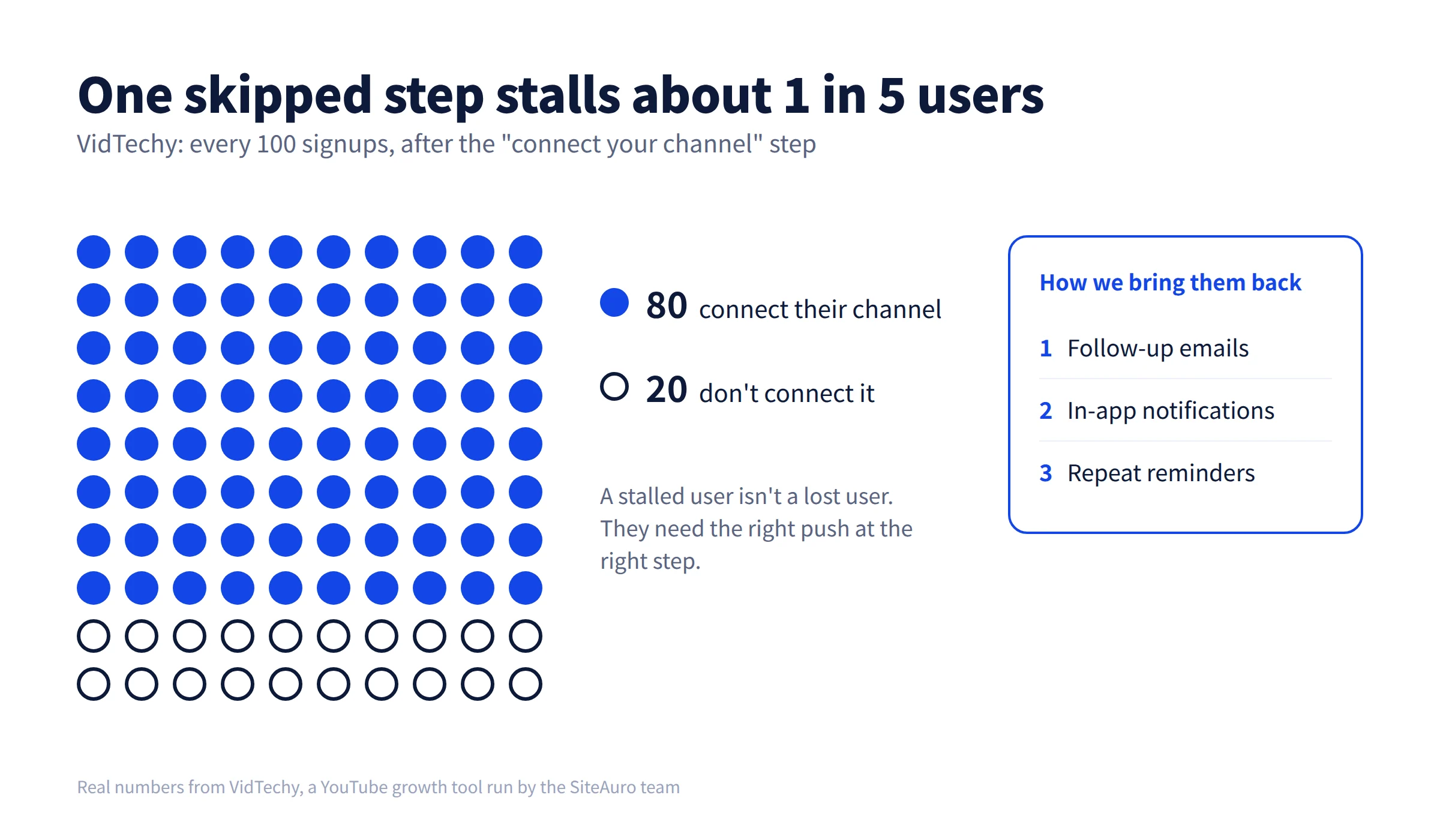
We see this in our own products. The team behind SiteAuro also runs VidTechy, a YouTube growth tool. After signup, users need to connect their YouTube channel. In practice, about 20 of every 100 signups don't. Without that step, they never see what the tool can do.
So we follow up with emails, in-app notifications, and repeat reminders. The lesson is simple. A stalled user isn't a lost user. They need the right push at the right step.
What Behavior Signals Predict Who Will Pay?
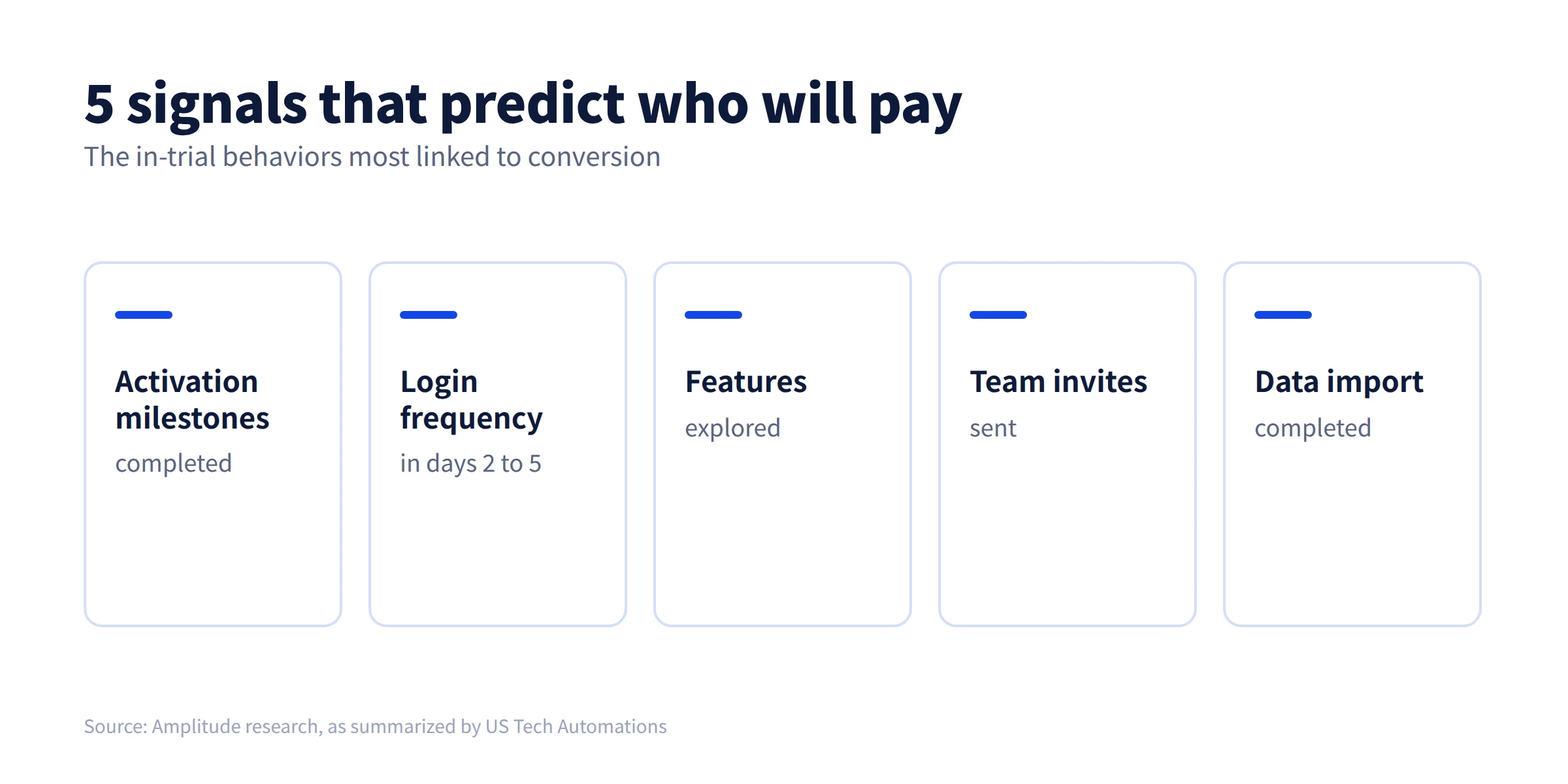
The strongest signals show progress toward value in the first few days. Research from Amplitude, as summarized by US Tech Automations, lists the top five:
- Activation milestones completed
- Login frequency in days 2 to 5
- Features explored
- Team invites
- Data import completion
These are all in-trial signals. But there is a second set most teams miss: what the user did before they signed up.
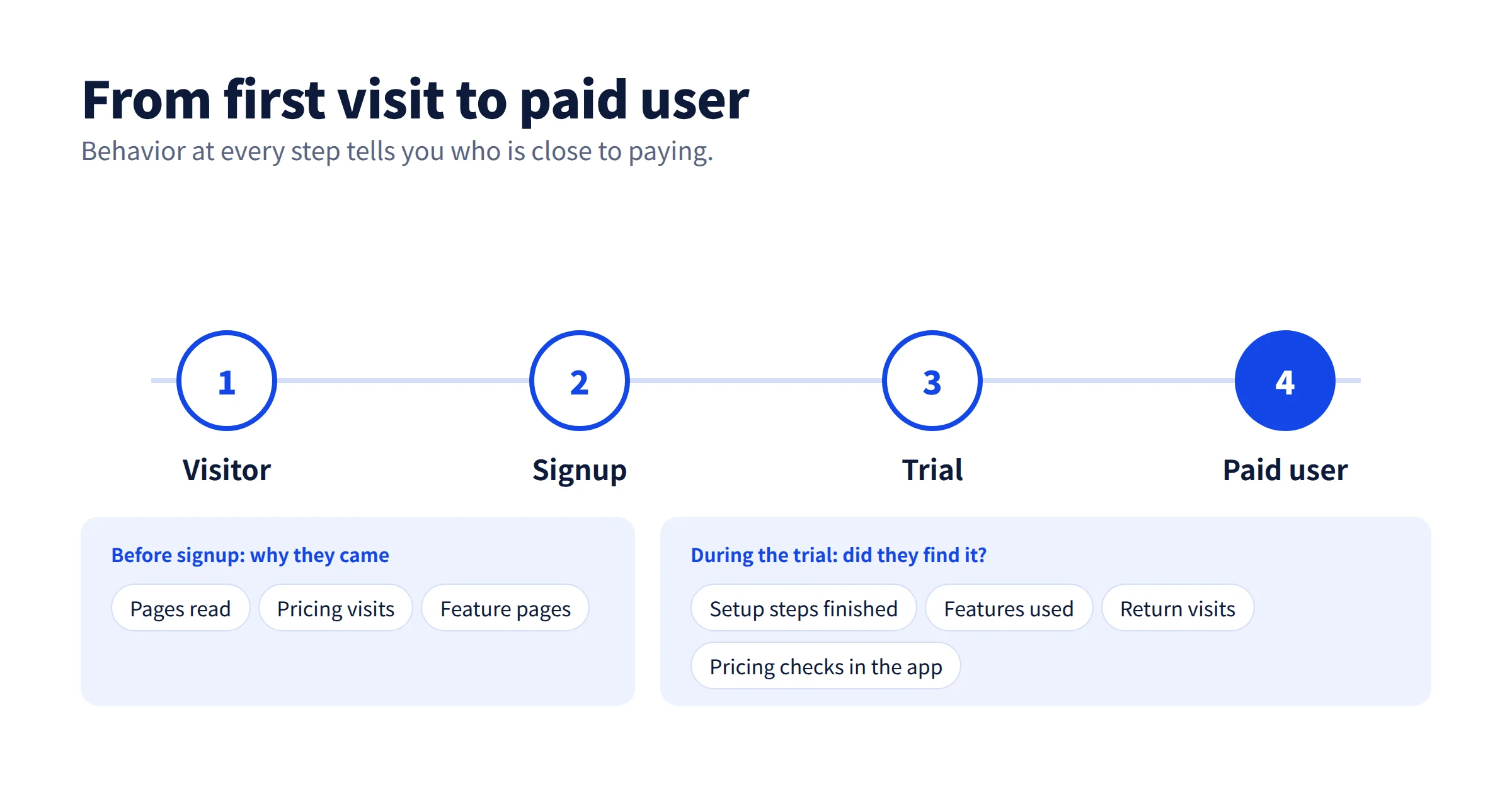
Pre-signup behavior tells you why someone came. For example:
- They read your integrations page twice. Integrations matter to them.
- They visited your pricing page three times. They are already weighing the cost.
- They spent time on one feature page. That feature is likely the reason they signed up.
Put both sets together and you know two things. What the user wanted, and whether they've found it yet.
How to Segment Trial Users by Behavior
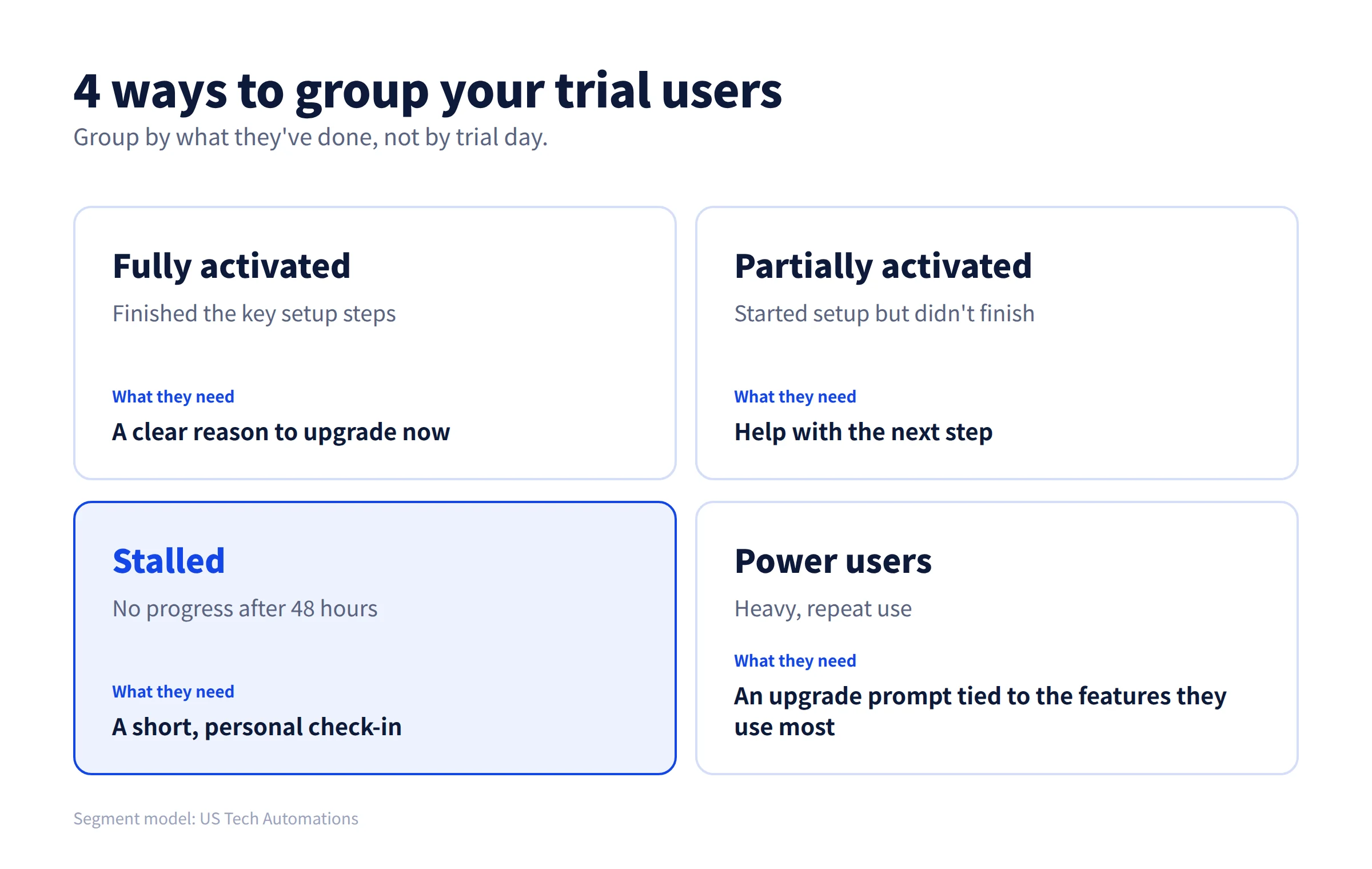
Group trial users by what they've done, not just by how many days they've been in the trial. Userpilot recommends grouping trial users by feature usage, activation status, survey answers, and days left in the trial. Then send upgrade messages based on the group.
One simple model splits trial users into four groups (US Tech Automations):
| Segment | What it means | What they need |
|---|---|---|
| Fully activated | Finished the key setup steps | A clear reason to upgrade now |
| Partially activated | Started setup but didn't finish | Help with the next step |
| Stalled | No progress after 48 hours | A short, personal check-in |
| Power users | Heavy, repeat use | An upgrade prompt tied to the features they use most |
In SiteAuro, the Segment Builder groups visitors into segments like these automatically, based on behavior. A segment can be as simple as "visited the pricing page 3+ times." Once the rule is set, users move in and out of the segment as their behavior changes. You don't sort lists by hand.
Turning Segments Into Action: In-App Upgrade Prompts and Trial Nudge Emails
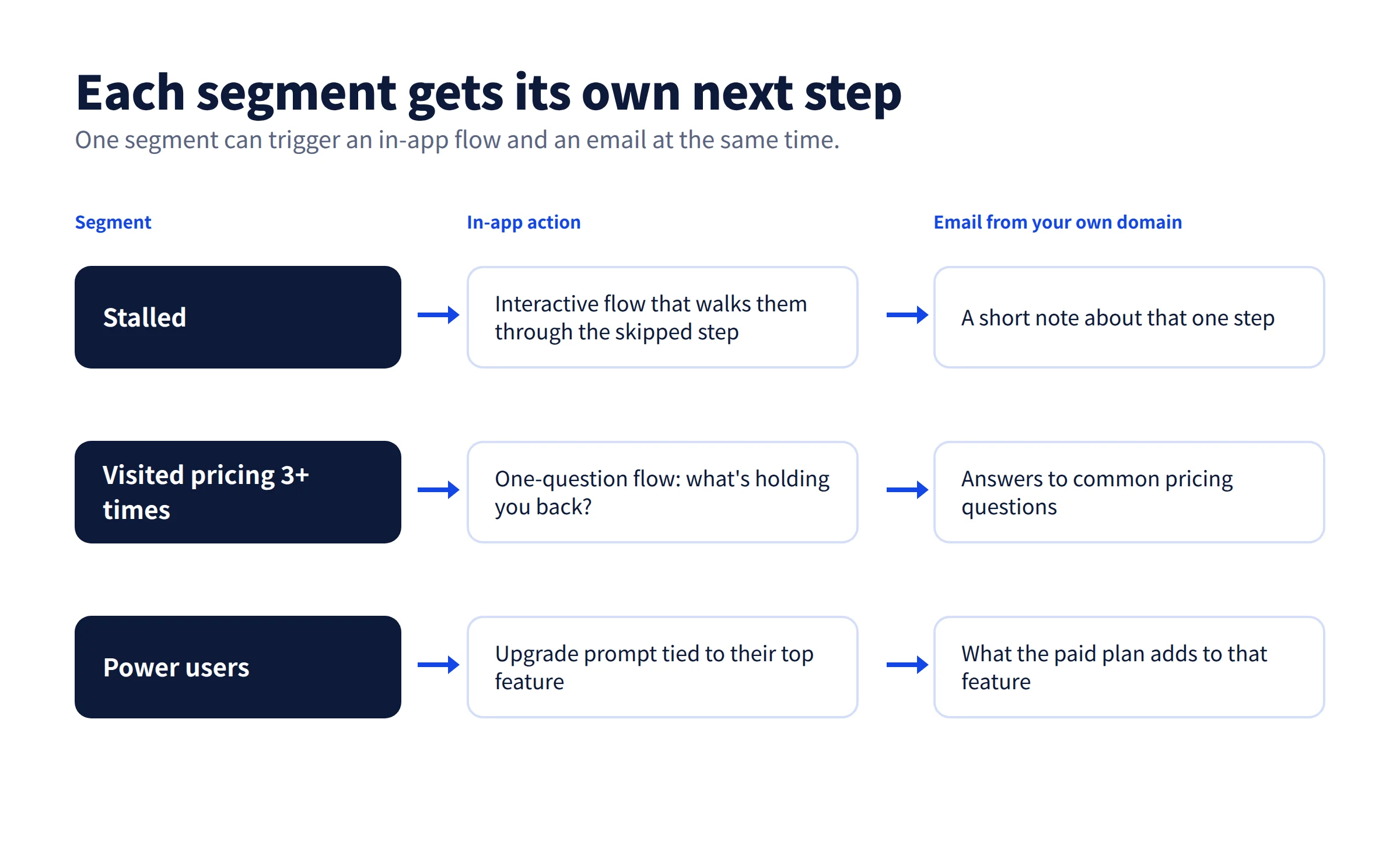
Each segment should trigger an action that fits it. In SiteAuro, every segment can trigger one or more actions at the same time: an email sequence, an interactive flow, or personalized content.
Here is how that looks for trial users:
| Segment | In-app action | Email action |
|---|---|---|
| Stalled | An interactive flow that walks them through the step they skipped | A short note about that one step |
| Visited pricing 3+ times | A one-question flow asking what's holding them back | An email that answers common pricing questions |
| Power users | An in-app upgrade prompt tied to the feature they use most | An email showing what the paid plan adds to that feature |
In-app upgrade prompts
An interactive flow can be a single question or a full multi-step flow with branches. You build it with a drag-and-drop builder. Each flow has a display setting, so you choose where it shows: your website, inside your app, or both.
That matters for trial users. An upgrade prompt inside the app reaches them while they are using the product, not after they've left.
Trial nudge emails
SiteAuro's email sequences can start on any segment match, not just when someone first signs up. So when a user stalls, the right email goes out then, not on a fixed day.
The emails send through your own SMTP, from your own domain. To the user, they look like a note from you, not a mass blast from a marketing tool.
Tracking where each user stands
The Contacts dashboard shows every contact with a status. You can see who is moving toward paid and who needs attention.
How "One Snippet, Two Jobs" Connects Pre-Signup and Post-Signup Data
Most tools see only one side of the user. A marketing tool tracks your website. A product analytics tool tracks your app. The story breaks at signup.
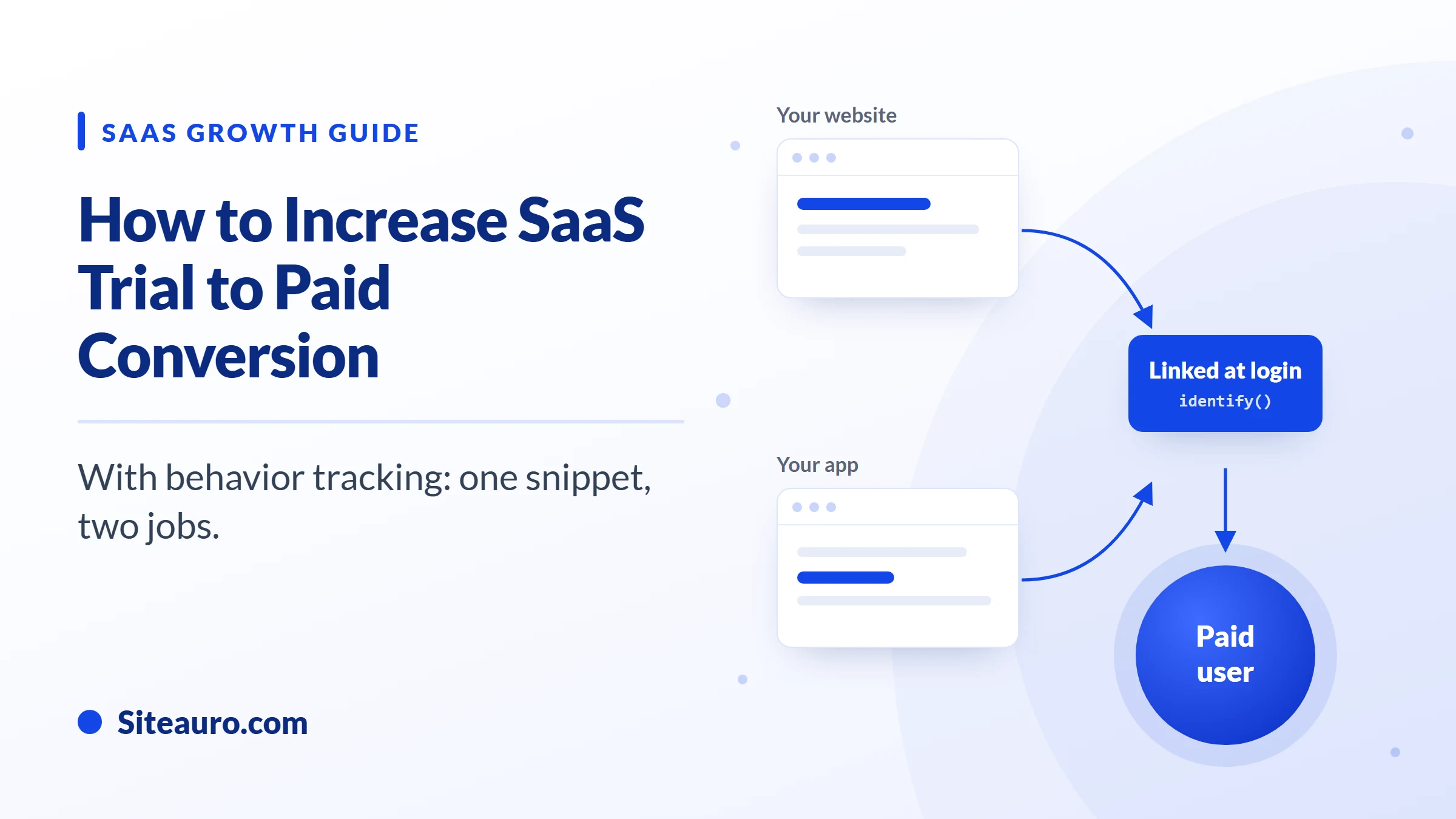
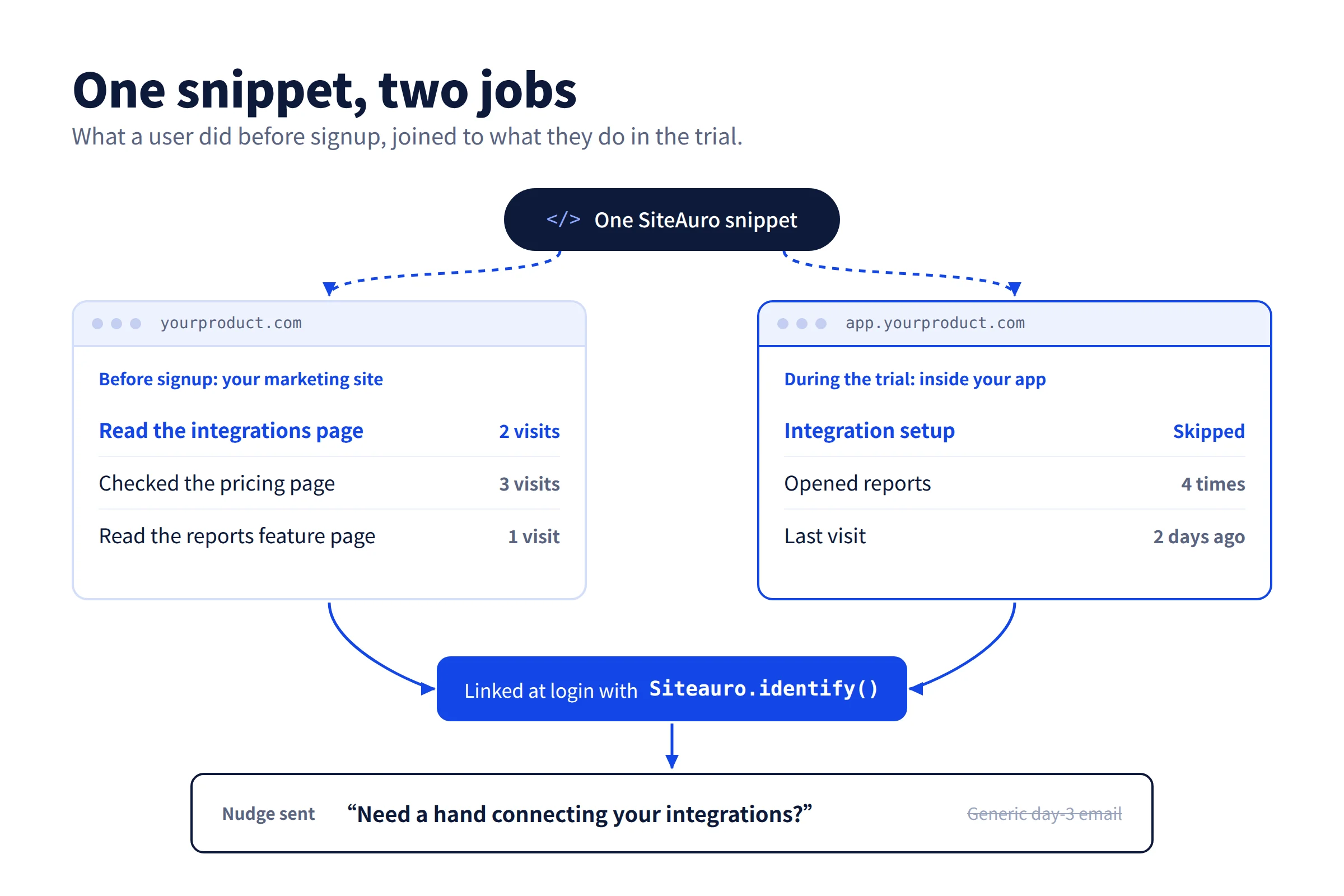
SiteAuro uses one tracking snippet for both. That's what we mean by "one snippet, two jobs." This In-App Mode is built for SaaS products.
Here's how it works:
- Add the snippet to your marketing site. The Smart Tracker records pages viewed, engagement, and time on site.
- Add the same snippet inside your logged-in app.
- Call
Siteauro.identify()when a user logs in. This links their activity before signup to their account after signup. - Build segments in the Segment Builder using behavior from both sides.
- Attach triggers like email sequences and in-app interactive flows.
Now think about one user. Before signing up, they read your integrations page twice. In the trial, they never set up an integration.
Without the link, they get the same day-3 email as everyone else. With it, they get an email and an in-app flow about integrations. That's the thing they came for.
The Smart Tracker uses a first-party cookie set through a CNAME record on your domain. That means it keeps working even with the tracking limits in Safari and Firefox.
Trial to Paid Conversion: Common Questions
What is a good free trial conversion rate for SaaS?
The median is about 8% across B2B SaaS (Userpilot). Pure self-serve trials sit lower, at 4.6%. Sales-assisted trials sit higher, at 17.4% (SaaS Hero). Compare yourself to products with the same sales model.
What is behavioral segmentation in SaaS?
Behavioral segmentation is grouping users by what they do, not by who they are. In a SaaS trial, that means groups based on actions like setup steps finished, pages visited, or features used. Each group then gets messages that fit its behavior.
When should I send trial nudge emails?
Send them when a user's behavior calls for it, not on a fixed schedule. A user who stalls after 48 hours needs a nudge right away. A power user is ready for an upgrade message early. A fixed day-3 email treats them both the same.
Do in-app upgrade prompts annoy trial users?
They annoy users when they ignore context. A prompt that shows up at random feels like an ad. A prompt tied to the feature someone just used feels helpful. Target prompts to segments and limit how often they show.
What's the difference between a lead and a signup?
A lead is someone who shared their contact details but hasn't created an account. A signup is someone who started a trial. They are separate stages. This guide covers the step after signup: turning trial users into paid users.
Does SiteAuro work with my existing tools?
Yes. SiteAuro supports Zapier and Webhooks. You can send data out by webhook and bring data in through the REST API.
The Bottom Line
Trial users tell you what they want through what they do. Before signup, they show you why they came. During the trial, they show you whether they've found it.
Connect those two views, group users by behavior, and respond to each group. That beats a generic day-3 email every time.
Get Your Free Lead Intelligence Map
Enter your website — see exactly how to turn more visitors into leads, and leads into customers.
Get Your Free Lead Intelligence MapSources
- Userpilot, "SaaS Average Conversion Rate": https://userpilot.com/blog/saas-average-conversion-rate/
- SaaS Hero, "B2B SaaS Conversion Benchmarks": https://www.saashero.net/strategy/b2b-saas-conversion-benchmarks-journey/
- US Tech Automations, "SaaS Trial-to-Paid Conversion ROI Analysis 2026": https://ustechautomations.com/resources/blog/saas-trial-to-paid-conversion-roi-analysis-2026

Karthick, Founder, SiteAuro
Building SaaS for Lead Generation & Conversion.