
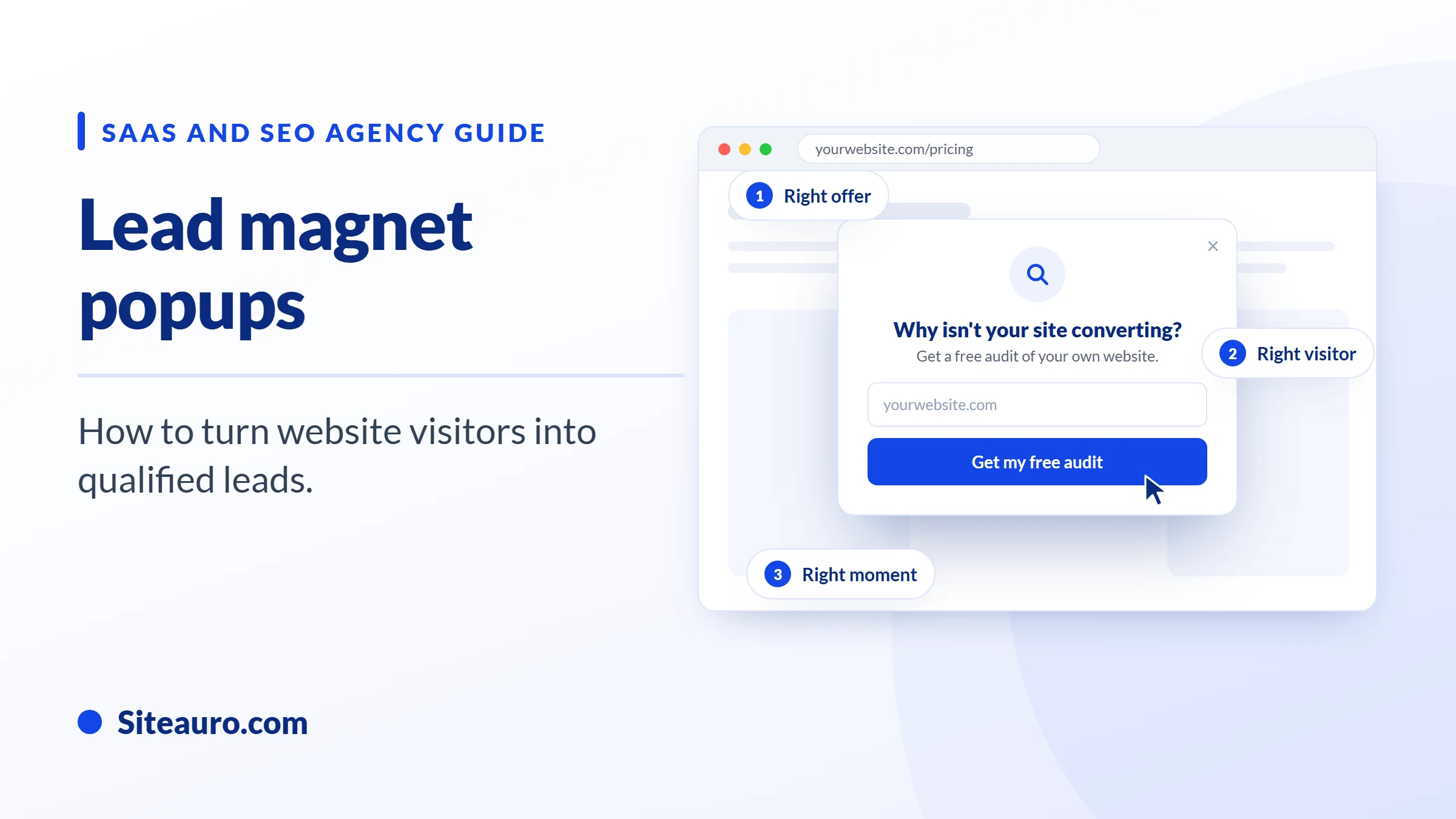
A lead magnet popup is a small window on your website that offers visitors something useful, like a free audit or a quick tool, in exchange for their email. The lead magnet is the value. The popup is how that value reaches the visitor.
Most websites get this wrong. They show the same popup, with the same offer, to every visitor, at the same moment. Then they wonder why so few people sign up.
This guide fixes that. You'll learn what lead magnets and popups are, which types work, and how to match the right offer to the right visitor at the right time. Then we'll go through specific ideas for SaaS founders and SEO agencies.
What Is a Lead Magnet?
A lead magnet is something useful you give a website visitor in exchange for their contact details. It's a trade. They get value. You get a way to follow up.
Common lead magnets include:
- A checklist or template
- A short guide or ebook
- A free audit or report
- A calculator or quiz
- A free mini-tool
- A webinar or email course
The format matters less than the problem it solves. A good lead magnet fixes one specific problem, fast, before you ask for anything more.
Here's a simple test. "Subscribe to our newsletter" is not a lead magnet. Nobody wakes up wanting more email. "See why your pricing page isn't converting" is a lead magnet. It promises a specific answer to a real problem.
Static vs Interactive Lead Magnets
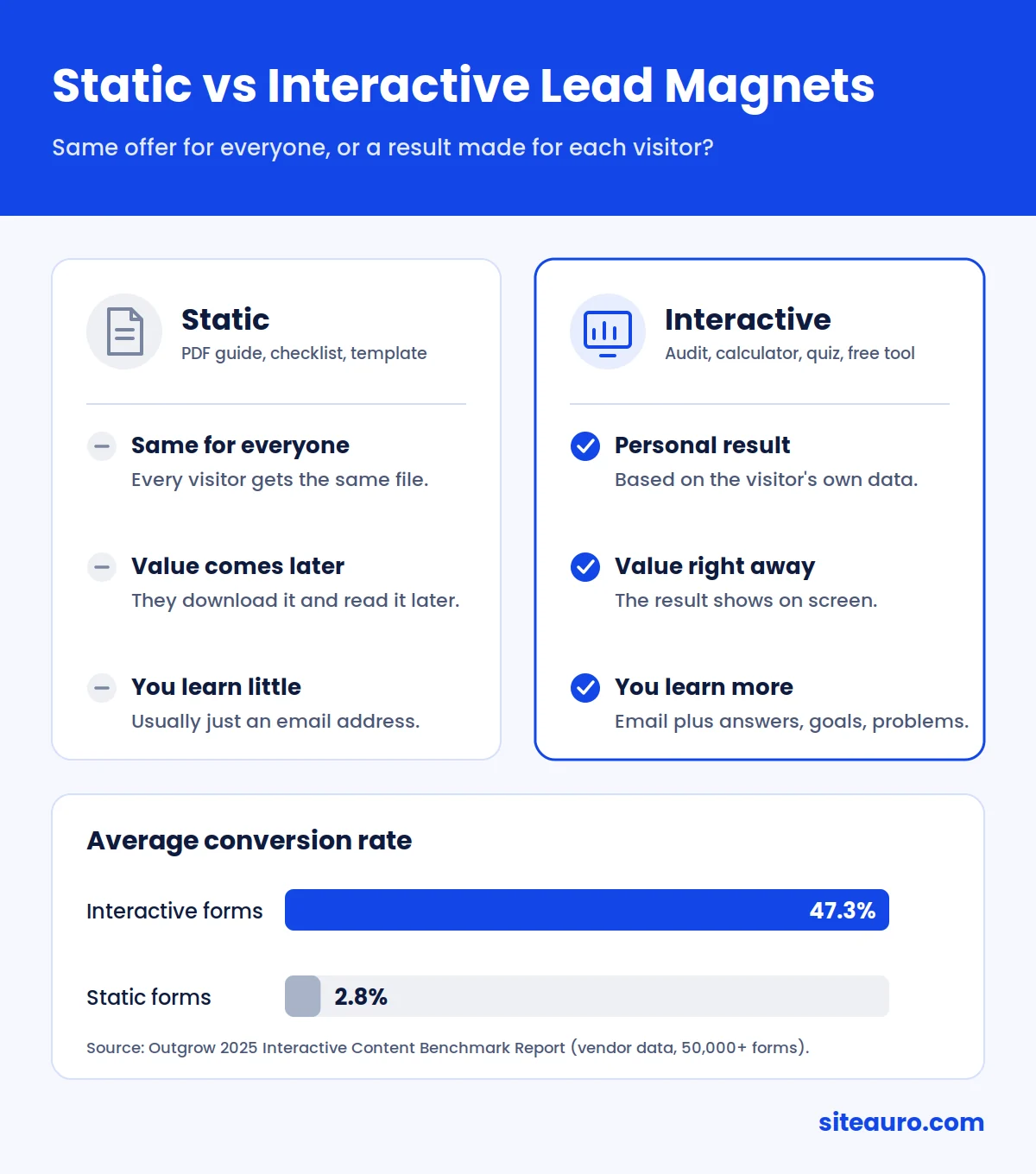
A static lead magnet gives every visitor the same thing. An interactive lead magnet gives each visitor a result based on their own input.
A PDF guide is static. A tool that scans your website and tells you what's broken is interactive.
| Static lead magnet | Interactive lead magnet | |
|---|---|---|
| Examples | PDF guide, checklist, template | Audit, calculator, quiz, free tool |
| When the visitor gets value | Later, after downloading and reading | Right away, on screen |
| Personal to the visitor? | No, same for everyone | Yes, based on their answers or data |
| What you learn about the lead | Usually just an email | Email plus their answers, goals, and problems |
| Effort to build | Low | Medium (lower with the right tool) |
Interactive lead magnets tend to convert much better. In its 2025 benchmark report, Outgrow found that interactive forms converted at 47.3% on average, compared with 2.8% for static forms, across more than 50,000 forms from 1,200 companies (Outgrow). Outgrow sells interactive content tools, so treat this as a direction, not a promise.
The reason is simple. With an interactive lead magnet, the visitor gets value first. The result feels made for them. And you learn far more about each lead than an email address can tell you.
What Is a Popup?
A popup is a small window that appears on top of a web page and asks the visitor to take one action. That action might be entering an email, answering a question, or claiming an offer.
A popup is not a lead magnet. It's the delivery method. A popup with nothing worth having is just an interruption.
So how well do popups work on average? Sumo studied nearly 1.75 billion popups. The average conversion rate was 3.09%. The top 10% averaged 9.28% (Sumo study via BDOW).
Sumo also found that popups with more context converted better. A random popup on the homepage converts poorly. A popup that matches what the visitor is doing converts far better. That idea runs through the rest of this guide.
Types of Popups and When to Use Each
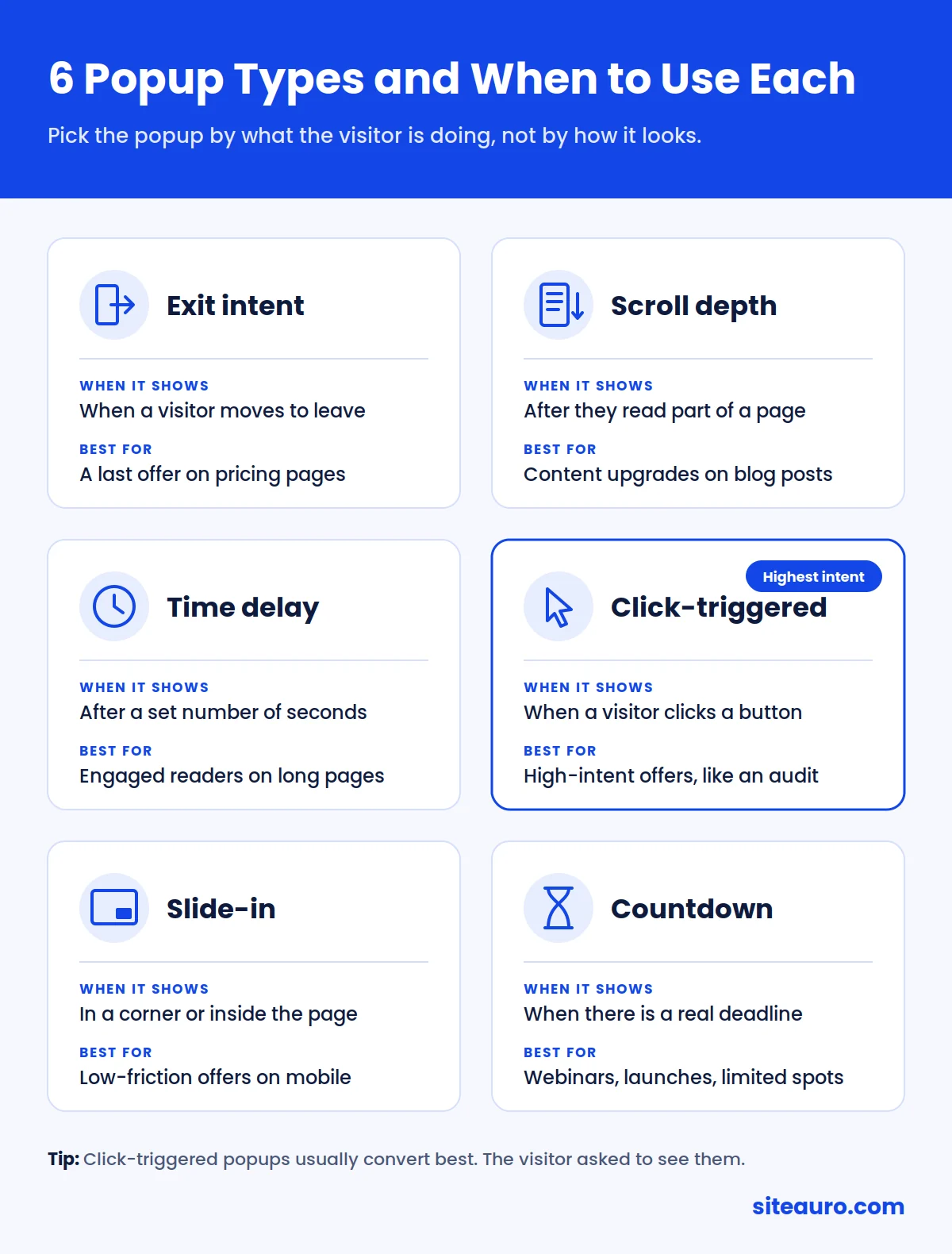
The type of popup decides when it appears. Pick the type based on what the visitor is doing, not on what looks nice.
| Popup type | When it appears | Best used for |
|---|---|---|
| Exit intent | When the visitor moves to leave the page | A last offer on pricing or service pages |
| Scroll depth | After the visitor reads part of a page | Content upgrades on blog posts |
| Time delay | After a set number of seconds | Engaged readers on long pages |
| Click-triggered | When the visitor clicks a button or link | High-intent offers like "Get my free audit" |
| Slide-in or inline | In a corner, or inside the page content | Low-friction offers that work well on mobile |
| Countdown | Shows a real deadline | Webinars, launches, or limited spots |
Click-triggered popups usually have the highest intent. The visitor asked to see them.
Seasonal and gamified popups, like spin-the-wheel offers, are common in ecommerce. For SaaS products and agencies, they often feel off-brand. Use them with care.
How a Lead Magnet Popup Works: Offer, Visitor, Moment
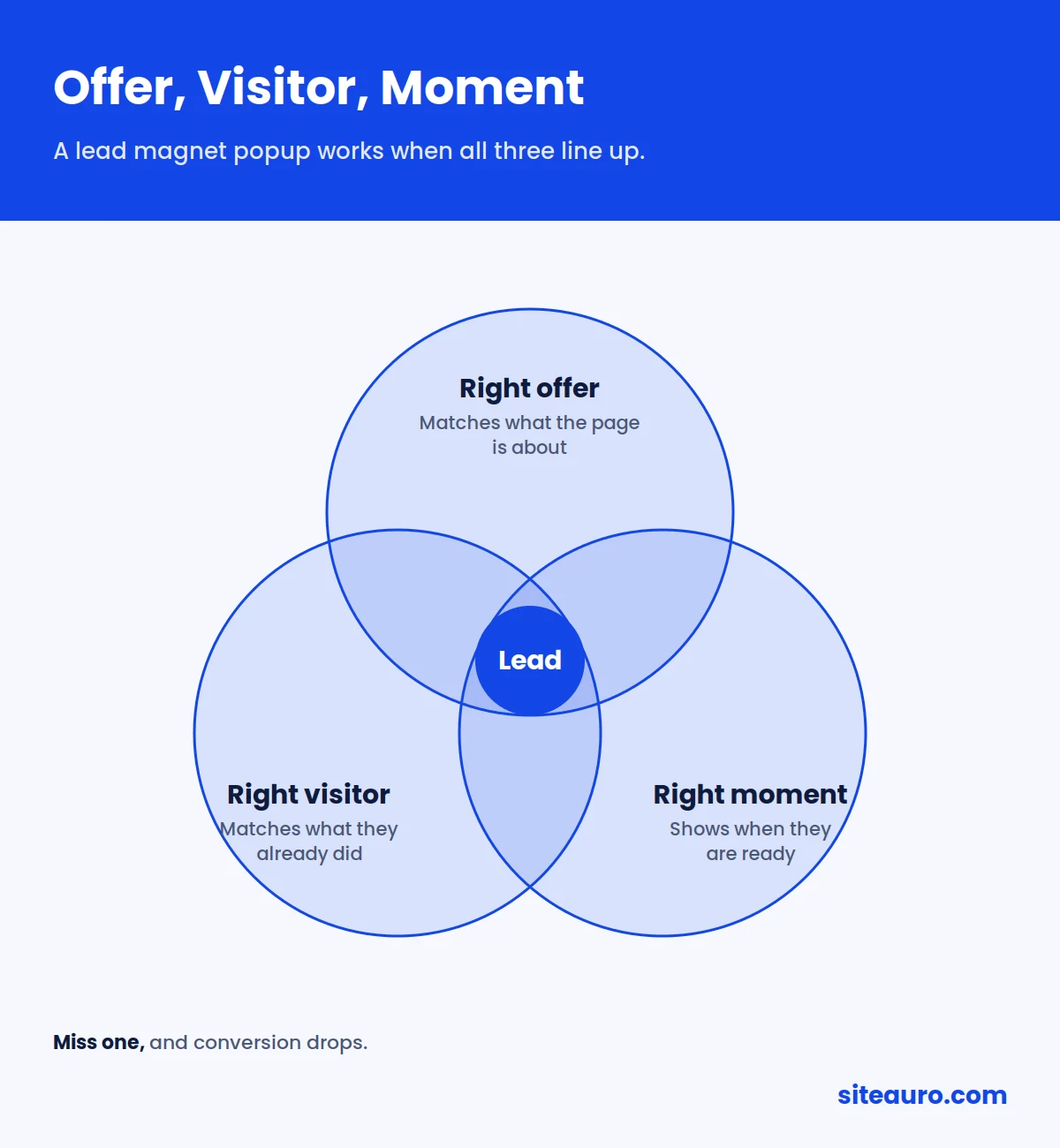
A lead magnet popup works when three things line up: the right offer, the right visitor, and the right moment. Miss one, and conversion drops.
- The right offer. It matches what the page is about. A visitor reading about technical SEO wants a technical SEO check, not a general newsletter.
- The right visitor. It matches what that person has already done on your site.
- The right moment. It shows when the visitor is ready, not the second they land.
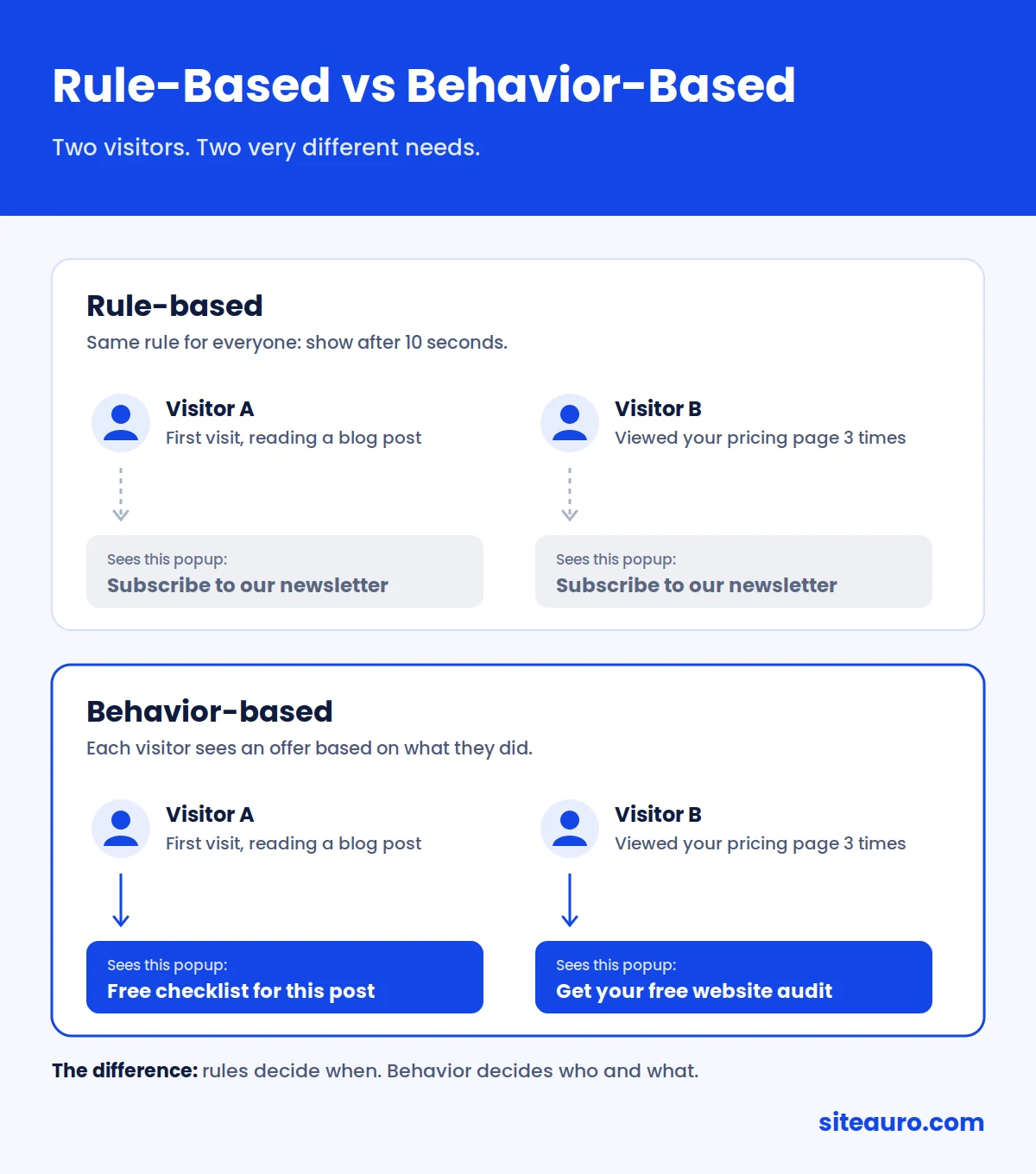
Most popup tools handle the moment with simple rules. Show after 10 seconds. Show on this page. Show on desktop only. That's rule-based targeting.
Behavior-based targeting goes further. It looks at what each visitor actually did. For example:
- Visited the pricing page three times this week
- Read three blog posts on the same topic
- Started a form and left before finishing
A first-time blog reader and someone who has viewed your pricing page three times are in very different places. They should not see the same popup. In practice, this one change often matters more than any design tweak.
Lead Magnet Popup Ideas for SaaS Founders
The best SaaS lead magnets let visitors see the problem your product solves, using their own data. If they can feel the problem, the product makes sense.
How the SaaS funnel works
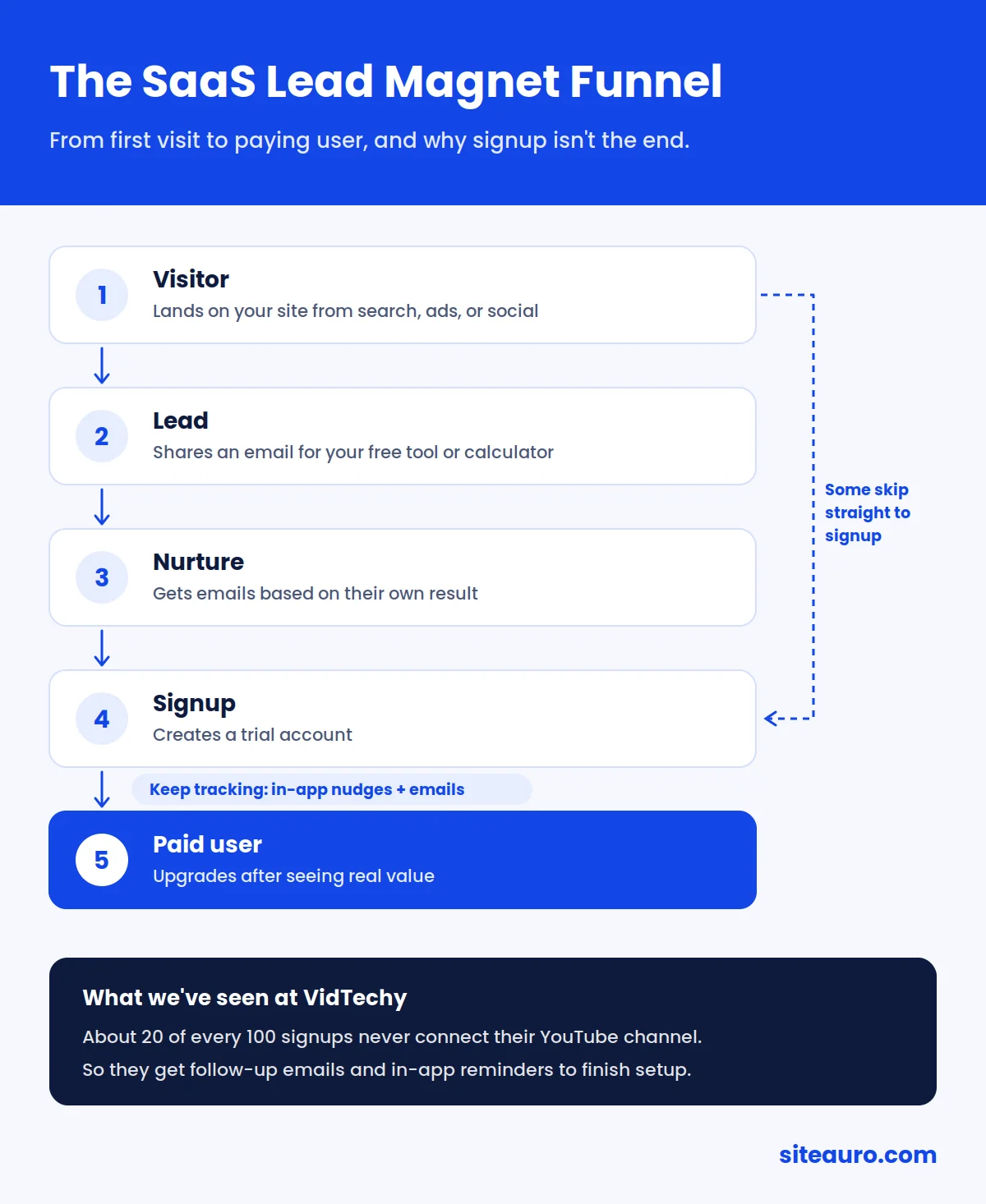
Most SaaS visitors are not ready to sign up on their first visit. A typical path looks like this:
- Visitor lands on your site.
- Lead shares an email in exchange for your lead magnet.
- Nurture emails build trust and show value.
- Signup creates a trial account.
- Paid user upgrades.
Some visitors skip straight to signup. That's great. The lead magnet is for everyone else, the people who are interested but not ready yet.
SaaS lead magnet ideas
| Lead magnet idea | Popup trigger | Where to place it |
|---|---|---|
| ROI or cost calculator | Exit intent | Pricing page |
| Readiness scorecard or quiz | Scroll depth | Blog posts about the problem you solve |
| Free mini-tool that does one job of your product | Click-triggered | Free tools page, homepage |
| Personal audit of the visitor's asset (for example, a LinkedIn profile audit or website audit) | Click-triggered | Homepage, feature pages |
| Template or checklist tied to one blog post | Scroll depth | That specific blog post |
| "How do you compare?" benchmark | Slide-in | Comparison and use-case pages |
| Use-case finder quiz | Time delay | Homepage |
Notice the pattern. The strongest ideas give the visitor a personal result. The weakest ones give everyone the same file.
What happens after you capture the lead
The lead magnet is only the start. Send a short email sequence based on the visitor's result. If the calculator showed they're losing time on manual reports, the emails should talk about manual reports. Generic "Welcome to our newsletter" emails waste the context you just collected.
Don't stop tracking at signup
Here's what many SaaS teams miss. Signing up is not the finish line. A trial user who never uses the core feature will not pay.
The same thinking that works on your website works inside your product. Watch what new users do. When someone gets stuck, send a helpful nudge by email or in the app.
What we've seen with VidTechy
We run VidTechy, a YouTube growth tool with nearly 14,000 users. Free tools, like a YouTube name generator and a description generator, bring in a large share of new signups. Visitors get real value with no catch, and many decide to create an account.
But signup alone wasn't enough. To get value from VidTechy, users need to connect their YouTube channel. About 20 out of every 100 new signups don't do this. So those users get follow-up emails, in-app notifications, and repeat reminders until they finish setup.
The lesson: a lead magnet gets people in the door. Tracking what they do next is what turns them into paying users.
SiteAuro handles both sides with one tracking snippet, on your marketing site and inside your logged-in product. We call it "One snippet, two jobs."
Lead Magnet Popup Ideas for SEO Agencies and Consultants
The best lead magnet for an SEO agency is a free, personalized SEO audit of the visitor's own website. Nothing else shows your value as clearly.
How the agency funnel works
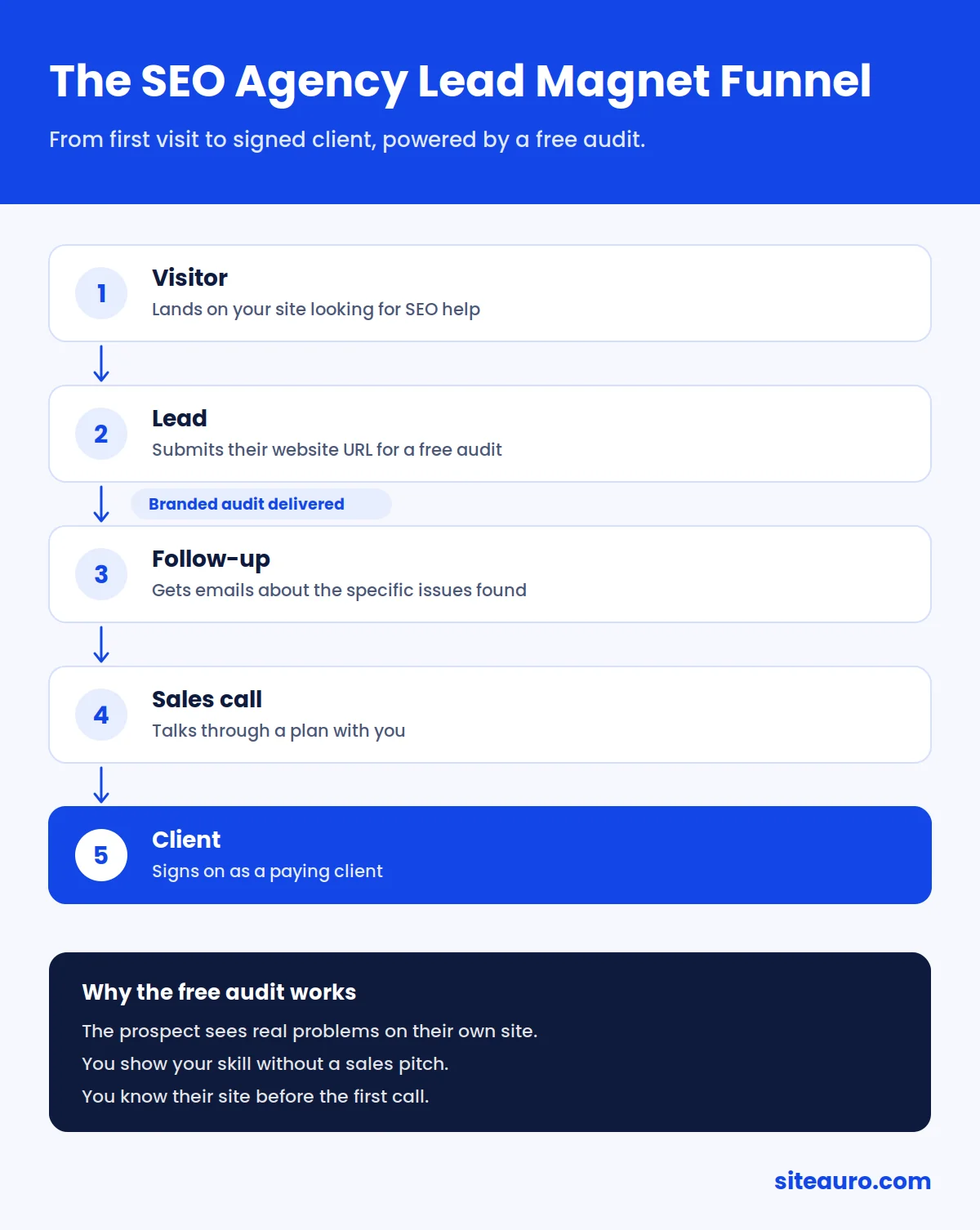
Most agency leads are not ready to hire you on their first visit. A typical path looks like this:
- Visitor lands on your site.
- Lead submits their website URL for a free audit.
- Follow-up emails point to the specific issues found.
- Sales call to talk through a plan.
- Client signs on.
The audit does three jobs at once. The prospect sees their own problems. You show your skill without a sales pitch. And you know their site before the first call.
SEO agency lead magnet ideas
| Lead magnet idea | Popup trigger | Where to place it |
|---|---|---|
| Free SEO audit of the visitor's website | Click-triggered | Homepage, services page |
| Page speed and Core Web Vitals check | Scroll depth | Technical SEO blog posts |
| Keyword gap snapshot against one competitor | Exit intent | Services and pricing pages |
| "Is your site ready for AI search?" score | Scroll depth | Blog posts on AI search |
| Content audit template | Scroll depth | Content strategy blog posts |
| Traffic drop diagnosis quiz | Exit intent | Blog posts about ranking drops |
| Case study plus "get the same audit" offer | Click-triggered | Case study pages |
What happens after you capture the lead
Follow up on what the audit found. "Your site has 14 pages with missing title tags" is a much better opening than "Let's hop on a call." Specific beats generic every time.
Send the first email within minutes, while the prospect still remembers asking for the audit.
What makes an agency audit convert
- Brand it as yours. Your logo, your colors, your name. The audit is your first impression.
- Keep it short. Show the top problems clearly. A 60-page report goes unread.
- Rank the issues. Show what to fix first. This shows you think like a strategist, not a tool.
- End with one next step. Book a call, or reply to the email. Not both.
This is the flow SiteAuro automates for agencies. The visitor submits their URL, an AI-generated audit goes out under your agency's brand, and the lead lands in your dashboard, ready for follow-up.
How to Build a Lead Magnet Popup That Converts
You build a lead magnet popup by choosing one problem, solving it fast, and showing it at the right moment. Here are the steps.
- Pick one problem. Choose the problem your best customers had before they found you.
- Choose the fastest format. If a two-minute quiz can answer it, don't write a 30-page guide.
- Ask the fewest questions possible. A website URL and an email are often enough. Every extra field costs you leads.
- Show value right away. Display the result on screen. Send a copy by email too.
- Match the trigger to intent. Use click-triggered popups for high-intent pages and scroll depth for blog posts.
- Write the headline about the outcome. "Find out why your site isn't ranking" beats "Free SEO audit tool."
- Follow up within minutes. Mention the visitor's actual result in your first email.
- Measure, then change one thing at a time. Test the headline, then the trigger, then the offer.
Popup Best Practices and Mistakes to Avoid
The best popups are relevant, well-timed, and easy to close. Fewer, better popups beat more popups.
| Do | Don't |
|---|---|
| Show popups based on what the visitor did | Show the same popup to everyone |
| Wait until the visitor shows interest | Block the page the second someone lands |
| Make the close button easy to find | Hide the close button or make it tiny |
| Use one clear message and one action | Cram in three offers and five form fields |
| Limit how often the same person sees it | Show it on every page, every visit |
| Use small banners or slide-ins on mobile | Cover the whole screen on a phone |
Mobile matters for SEO too. Since January 2017, Google may rank mobile pages lower when a popup covers the main content right after a visitor arrives from search. Legal popups, like cookie notices and age checks, and small banners that use a reasonable amount of space are fine (Google Search Central).
How to Measure Lead Magnet Popup Performance
Measure a lead magnet popup by how many good leads it creates, not just how many emails it collects.
| Metric | What it tells you |
|---|---|
| View rate | How many visitors actually see the popup |
| Conversion rate | How many viewers take the action. Sumo's average is 3.09%, and the top 10% reach 9.28% |
| Completion rate | For multi-step flows, how many people finish |
| Lead-to-signup or lead-to-call rate | Whether leads take the next step |
| Close or dismiss rate | Whether the popup annoys people |
| Revenue per lead | Whether the leads turn into paying customers |
Conversion rate alone can fool you. A popup that converts at 10% but brings in people who never buy is worse than one at 4% that brings in real buyers. Always look one step further down the funnel.
FAQ
What is a lead magnet popup?
A lead magnet popup is a popup window that offers visitors something useful, like a free audit, tool, or checklist, in exchange for their contact details. The lead magnet is the offer. The popup is how it's shown.
Do popups hurt SEO?
Popups can hurt SEO on mobile if they cover the main content right after a visitor arrives from Google. Small banners, slide-ins, click-triggered popups, and legally required popups are generally safe. Desktop popups are not part of Google's intrusive interstitial guidance.
What is the best lead magnet for an SEO agency?
A free, branded SEO audit of the visitor's own website is the strongest lead magnet for most SEO agencies. It shows the prospect real problems on their site and proves your skill before the first call.
What is the best lead magnet for a SaaS company?
The best SaaS lead magnet is usually a free tool or calculator that solves a small version of the problem your product solves. It lets the visitor feel the problem and see your value using their own data.
How many questions should a lead magnet ask?
Ask as few as you can while still giving a useful result. For many audits, a website URL and an email are enough. Add a question only if it clearly improves the result or helps you qualify the lead.
Popup or landing page: which is better?
Use both, for different jobs. A popup works for visitors already on your site. A dedicated landing page works better for ads and campaigns, where the whole page can focus on one offer.
Are interactive lead magnets worth the extra effort?
For most SaaS companies and agencies, yes. Interactive lead magnets give visitors a personal result and give you far more information about each lead than a static download.
Where SiteAuro Fits
SiteAuro is a visitor intelligence and lead generation platform. It does what this guide describes, automatically.
The Smart Tracker records what each visitor does on your site. The Segment Builder groups visitors by behavior, such as "visited pricing three or more times." Each segment can then trigger one or more actions: a popup (interactive flow), an email sequence, an on-page widget, or personalized page content.
Interactive flows range from a single question to a full multi-step, branching flow built with drag and drop. So you can start simple and grow from there.
- For SaaS founders: build your own branded lead-gen tool, like a LinkedIn Profile Audit or Website Audit. Then keep tracking users after signup with the same snippet, and nudge trial users toward paid plans.
- For SEO agencies and consultants: turn a visitor's website URL into an AI-generated SEO audit, branded as your own and delivered automatically.
Emails send through your own SMTP, so they come from your domain and feel personal, not automated. Leads can flow to your other tools through Zapier and Webhooks.
Get Your Free Lead Intelligence Map
Enter your website — see exactly how to turn more visitors into leads, and leads into customers.
Get Your Free Lead Intelligence MapSources
- Outgrow, Why Interactive Forms Are Beating Old Lead Gen in 2025: https://outgrow.co/blog/interactive-forms-lead-generation-2025/
- Sumo pop-up conversion study (via BDOW): https://bdow.com/?p=10193
- Google Search Central, Helping users easily access content on mobile: https://developers.google.com/search/blog/2016/08/helping-users-easily-access-content-on

Karthick, Founder, SiteAuro
Building SaaS for Lead Generation & Conversion.