
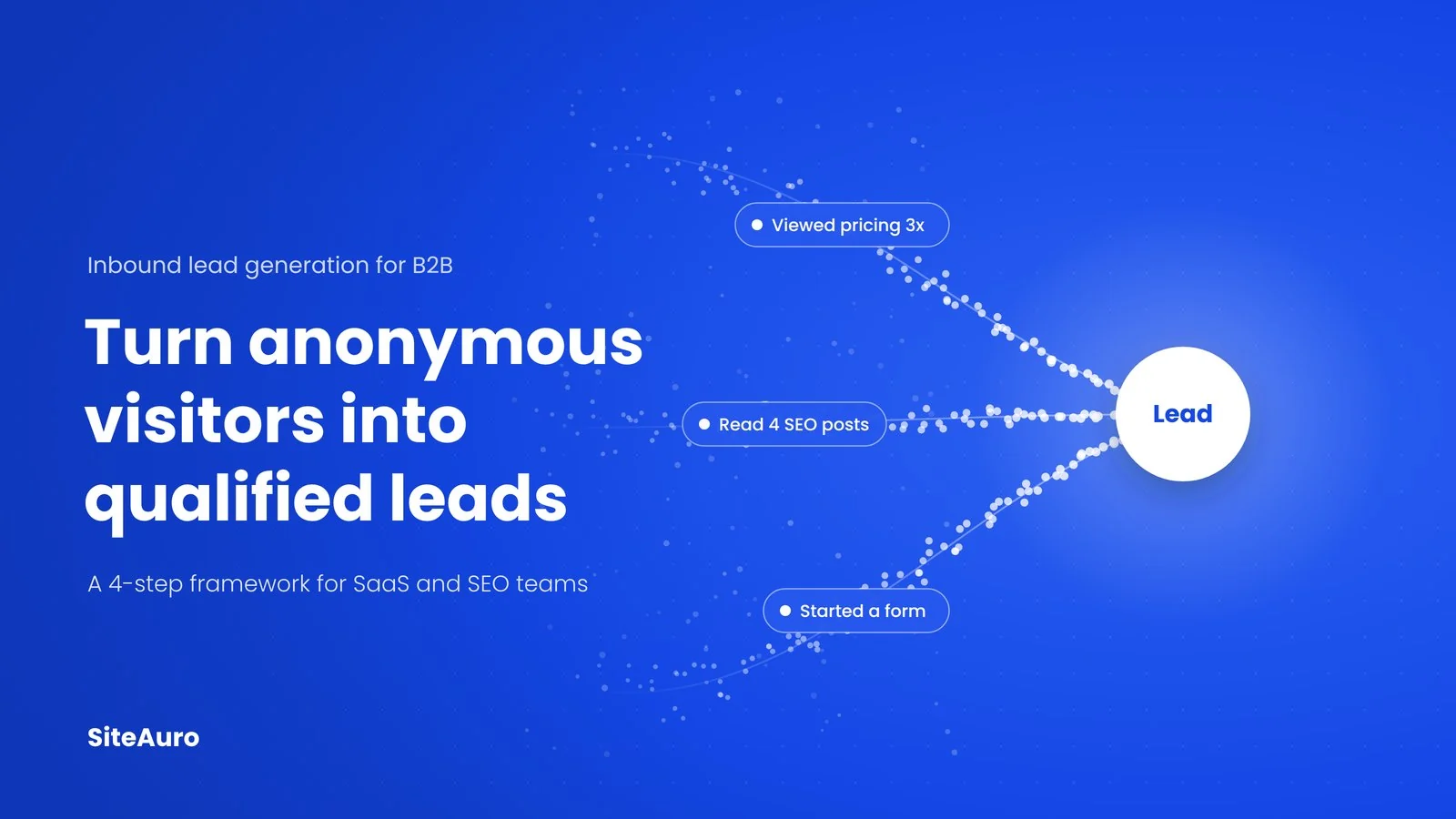
Your website gets traffic. Most of it leaves without a trace.
Inbound lead generation closes that gap. Not by getting more visitors, but by doing more with the ones you already have.
In B2B, the starting point is low. First Page Sage’s 2026 benchmarks put the average B2B SaaS website at about 1.1% visitor-to-lead conversion (SerpSculpt, 2026). That means roughly 99 of every 100 visitors leave without sharing an email.
This guide shows you how to change that. You’ll learn how to read what visitors do on your site, group them by intent, show each group the right offer, and follow up while they still care.
What Is Inbound Lead Generation?
Inbound lead generation is the process of attracting people to your website and giving them a good reason to share their contact details. You offer value first. They raise their hand second.
Outbound is the opposite. You reach out to people who never asked to hear from you, through cold emails, cold calls, or ads.
Inbound works because the buyer comes to you. They are already looking for an answer. Your job is to give them a useful next step before they leave.
Lead vs. Signup: Two Different Stages
These two words get mixed up a lot. They mean different things.
- A lead is a person who shared their contact details, like an email, in exchange for something useful. They have not created an account yet.
- A signup is a person who created an account, often a free trial.
Most visitors take one of two paths:
- Visitor → Lead → Signup → Paying customer. This is the most common path. The lead is nurtured by email until they’re ready to sign up.
- Visitor → Signup → Paying customer. Some visitors skip the lead stage and sign up right away.
A good inbound system plans for both paths.
Why Most Website Visitors Never Become Leads
Most visitors leave because the site shows everyone the same thing, no matter why they came. Here’s where the typical setup breaks.
- One page for everyone. A first-time reader and a buyer who checked your pricing page three times see the exact same site.
- One ask for everyone. “Book a demo” is too big a step for someone who just found you. It’s often the right step for someone comparing tools.
- Waiting for the form. Most teams only learn about a visitor after they fill out a form. But most visitors never fill one out.
- Slow follow-up. By the time someone replies, the buyer has moved on.
That last one costs more than most teams think. In a well-known Harvard Business Review study, firms that tried to contact a lead within an hour were nearly 7 times more likely to qualify that lead than firms that waited even one hour longer. They were over 60 times more likely than firms that waited 24 hours or more (Harvard Business Review, 2011).
The same study found the average response time was 42 hours. Most leads are cold long before that.
How Buyer Intent Shows Up Before the Form
Buyer intent is what a visitor’s actions tell you about how close they are to buying. You don’t need their name to see it. You just need to watch what they do.
Here are common signals and what they often mean.
| What the visitor does | What it often means | A good next step to offer |
|---|---|---|
| Reads one blog post, then leaves | Early research | A related guide or checklist |
| Reads 3 or more posts on one topic | Real interest in the problem | A tool or audit on that topic |
| Visits the pricing page 2 or more times | Weighing the cost | A comparison or a short call |
| Views a comparison or “alternatives” page | Choosing between options | A side-by-side guide |
| Starts a form, then stops | Interested but unsure | A shorter ask or one quick question |
| Comes back within a few days | Still thinking about it | A message that picks up where they left off |
No single click proves someone will buy. A pattern of clicks is worth acting on.
A 4-Step Inbound Lead Generation Framework
The framework is simple: track, group, trigger, follow up. It works with any tool stack.
Step 1: Track What Visitors Do
Start by recording what people do on your site. Track which pages they view, how often they return, how long they stay, how far they scroll, and which forms they start.
This is often called visitor intelligence. It’s different from standard analytics. Analytics tells you what happened across all your traffic. Visitor intelligence tells you what one visitor did, so you can respond to that visitor.
Step 2: Group Visitors by Behavior
Next, sort visitors into groups based on what they do. This is called behavioral segmentation. A segment is a group of visitors who share a pattern, like “visited pricing 3 or more times.”
Start small. Three to five segments is plenty at first:
- New visitors who read one post
- Return visitors who read several posts on one topic
- High-intent visitors who viewed pricing or a comparison page
- Visitors who started a form but didn’t finish it
- For SaaS: trial users who signed up but skipped the key first step
Each segment should answer one question. What does this group need next?
Step 3: Show the Right Offer at the Right Moment
Once you have segments, match each one to an offer. A trigger is a rule that says “when a visitor joins this segment, do this.”
Common triggers include:
- An interactive flow. This can be a single question or a multi-step flow that changes based on each answer.
- An email sequence. A short series of emails that starts when someone joins a segment.
- An on-page widget. Reviews, social proof, or a short survey shown to the right visitors.
- Personalized content. Page text that changes to match the visitor’s interest.
Match the size of the ask to the visitor’s intent. A first-time reader might answer one question. A repeat pricing visitor might book a call. Asking for too much too early is one of the fastest ways to lose someone.
Here’s an example. A visitor reads three of your posts about technical SEO. Instead of a generic newsletter box, you offer a free technical SEO check of their own site. The offer matches what they’re already trying to learn.
Step 4: Follow Up Fast, Then Nurture
Capturing a lead is the start, not the finish. Follow up while interest is fresh, and mention what the person actually did.
Good follow-up emails do three things:
- Deliver what you promised right away.
- Mention the topic they cared about, not a generic pitch.
- Give one clear next step, like starting a trial or booking a call.
Send from your own domain and a real person’s name when you can. It reads like a message, not a mass email.
Nurturing is how a lead becomes a signup. Most leads aren’t ready on day one. A short series of useful emails, spaced over a few days, keeps you in mind until they are.
Don’t Stop Tracking After the Signup
For SaaS teams, a signup is not the end of the funnel. It’s the middle. Many trial users sign up and then stall before they get any value.
We’ve seen this firsthand at VidTechy, a YouTube growth tool we run. VidTechy offers free tools, like a YouTube name generator and a description generator. These tools turn search traffic into signups.
But after signing up, users need to connect their YouTube channel to get real value. About 20 out of every 100 signups don’t do it.
So we track that one step. Users who skip it get follow-up emails and in-app notifications, with repeat nudges until they connect. Without that tracking, those users would quietly drop off. Today VidTechy has over 9,000 free users and more than 4,600 paying users.
The lesson is simple. Track the key action after signup, not just the signup. Then step in when someone gets stuck.
Inbound Lead Generation for SaaS vs. SEO Agencies
The framework stays the same. The signals and offers change.
| SaaS founders and growth teams | SEO agencies, consultants, and freelancers | |
|---|---|---|
| Main goal | Turn visitors into trial signups, then paying users | Turn visitors into discovery calls, then clients |
| High-intent signal | Visits to pricing, integrations, or comparison pages | Visits to SEO service pages or case studies |
| Best lead magnet | A free tool or audit tied to your product | A personalized SEO audit of the visitor’s website |
| Follow-up | Emails based on the features they explored | Audit results plus a call invite |
| After conversion | In-app nudges toward the key first action | Proposal, then onboarding |
For SaaS Founders and Growth Teams
Your job has two halves. First, turn visitors into signups. Then, turn signups into paying users.
Watch for visitors who move from product pages to pricing to integrations. That’s a buying journey. Offer a tool or comparison that fits what they’re checking, then follow up based on the features they viewed. After signup, track the one action that predicts a user will stay.
For SEO Agencies, Consultants, and Freelancers
Your prospects want proof before they pay. A personalized audit gives them that proof on day one.
When a visitor reads your SEO service pages, offer to audit their site. They see their own problems, in a report with your brand on it. Your follow-up starts with real findings instead of a cold pitch. The discovery call becomes a walkthrough, not a sales call.
The Best Lead Magnets for B2B Inbound
A lead magnet is something useful you offer in exchange for contact details. The best ones solve one specific problem fast and give a personal result.
| Format | Best for | Why it works |
|---|---|---|
| Audits and analyzers | SEO agencies, SaaS | Shows visitors their own problems. Opens the sales talk naturally. |
| Generators | SaaS, growth teams | Saves time right away. VidTechy’s name generator is one example. |
| Quizzes | Sorting visitors into segments | Visitors learn what they need. You learn which segment they fit. |
| Calculators | ROI-focused buyers | Turns a vague benefit into a real number. |
Personal beats generic. A PDF everyone gets is easy to ignore. A report about the visitor’s own website is hard to ignore.
Common Inbound Lead Generation Mistakes
- Sending all traffic to the same page. Different visitors need different next steps.
- Asking for too much too soon. A demo request is a big ask for a first visit.
- Ignoring anonymous visitors. They are most of your traffic. You can act on their behavior before you know their name.
- Using long forms. Ask only for what you need now. Learn the rest later.
- Following up slowly. Interest fades in hours, not weeks.
- Treating every lead the same. A repeat pricing visitor and a one-time reader need different follow-up.
- Stopping at the signup. For SaaS, the trial is where many users quietly drop off.
How to Measure Inbound Lead Generation
Measure each stage on its own. One overall number hides where people drop off.
| Metric | What it tells you |
|---|---|
| Visitor-to-lead rate | How many visitors share their contact details |
| Lead-to-signup rate | How well your nurture emails work |
| Signup-to-paid rate | How well you guide trial users to value |
| Conversion rate by segment | Which visitor groups respond best |
| Flow completion rate | How many people finish your interactive flows |
| Time to first follow-up | How fast you reach new leads |
Track these by segment, not just site-wide. That’s how you see which offers work for which visitors.
Frequently Asked Questions About Inbound Lead Generation
What is the difference between inbound and outbound lead generation?
Inbound brings buyers to you through useful content and offers. Outbound means you reach out first, through cold emails, calls, or ads. Inbound leads usually arrive already knowing what problem they want to solve.
What is a good visitor-to-lead conversion rate for B2B?
It depends on your industry. First Page Sage’s benchmarks put B2B SaaS at about 1.1% and the overall B2B median near 1.9% (SerpSculpt, 2026). Your own trend over time matters more than any average.
Can you generate leads from anonymous website visitors?
Yes. You don’t need to know who someone is to respond to what they do. Track their behavior, show an offer that matches it, and many will share their email in return.
How fast should you follow up with an inbound lead?
Within the hour, and sooner if you can. Harvard Business Review found that firms contacting leads within an hour were nearly 7 times more likely to qualify them (HBR, 2011). Automated emails make this possible without a sales team on standby.
Do you need a big team to run inbound lead generation?
No. Once your segments and triggers are set, they run on their own. A small team can review results each week and adjust what isn’t working.
What is the best lead magnet for an SEO agency?
A personalized SEO audit of the visitor’s own website. It shows real problems, proves your skill, and gives you a natural reason to follow up.
How SiteAuro Puts This Framework to Work
SiteAuro is a visitor intelligence and lead generation platform built for SaaS founders and SEO agencies. It runs the four steps in this guide automatically.
- Smart Tracker records visitor behavior with a first-party cookie, built to work with Safari and Firefox privacy limits.
- Segment Builder groups visitors by what they do, like “visited pricing 3 or more times.”
- Triggers run from each segment: email sequences, interactive flows, on-page widgets, or personalized content.
- For SaaS teams: One snippet, two jobs. The same snippet tracks visitors on your marketing site and users inside your product, so you can nudge trial users toward paid plans.
- For SEO agencies: A visitor enters their website URL. AI generates a personalized SEO audit with your agency’s branding and delivers it automatically.
Emails send through your own SMTP, so they come from your domain. Zapier and Webhook connect SiteAuro to the rest of your stack.
Get Your Free Lead Intelligence Map
Enter your website — see exactly how to turn more visitors into leads, and leads into customers.
Get your free Lead Intelligence Map
Karthick, Founder, SiteAuro
Building SaaS for Lead Generation & Conversion.